


Read the stories of those most impacted by the deportation machine. Stories often help us understand different perspectives. In a world where most headlines about immigrants and refugees are negative and misleading, we all deserve the truth. We all deserve real stories, ones that center our shared humanity, connection, and compassion.
These stories are just a handful that our community holds. While our voices may have the same elements and themes, everyone’s experience is different. We hope by sharing these stories that our larger community can firmly stand strong against deportations and give love and support to our impacted community through the MN8 Deportation Defense & Relief Fundraiser. View the short stories of Southeast Asian individuals facing the impacts of double punishment and family separation:
Tai was only 7 years old when his father made a fateful decision to flee Vietnam in search of a better future. Raised in a war-torn country under his mother and grandma’s care, Tai and his family faced hunger and uncertainty. At 13 years old, Tai, his two younger siblings, and his mom were granted permission to reunite with his father in the United States. As a young child, Tai was eager to see his dad again and embark to a land full of opportunities.
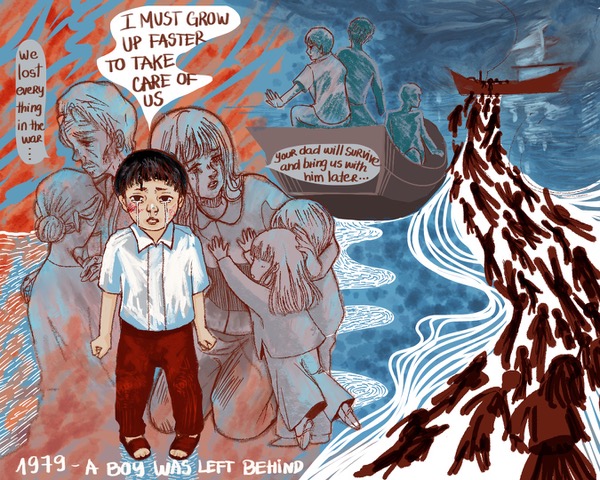
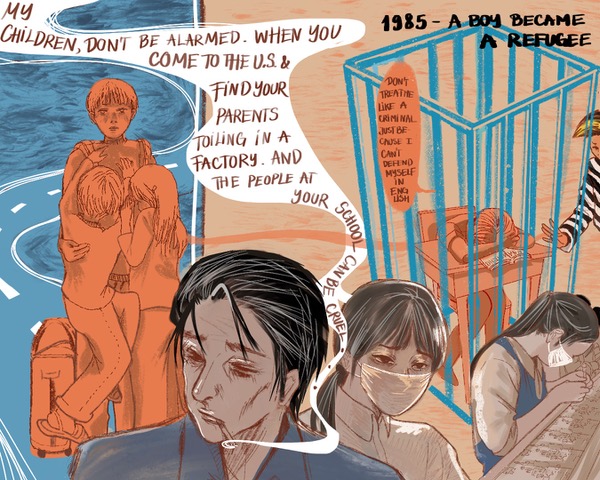
Except life in the U.S. wasn’t what Tai had hoped for. “I thought it would be better here in the U.S. but it wasn’t what it was supposed to be.” He saw his parents struggle to get by, working labor intensive jobs on the assembly line.
At school, Tai faced severe discrimination at school. Being a small kid, Tai was often bullied at school, getting kicked, pushed, and yelled at. Tai was always really scared and didn’t want to fight back in fear that they would hurt him more or that he would get in trouble. It wasn’t until a couple years later that things started looking up for him. Tai found friends and fell into an adolescence of survival. After establishing a sense of community, he felt empowered and safe for the first time ever. Just when Tai’s life started feeling more secure, he encountered new fears and obstacles.
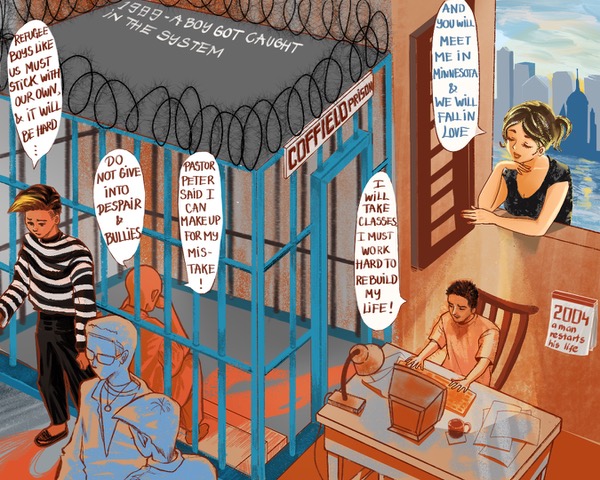
An 18 year old Tai got into trouble that changed everything. It was all a blur as he went through trial for almost a year. He followed his lawyer’s direction, taking a plea bargain, and focused on serving his time, unaware of the life altering consequences it would bring him. The first few years in prison were brutal. Tai had to protect himself at all times, often sleeping with one eye open in case someone tried to hurt him. “People get killed in prison all the time, even the guards and police can’t do much.” Familiar feelings of uncertainty and fear resurfaced.
After being released at 29 years old, Tai was ready to start his life again, “I was so happy but I was scared at the same time too, scared of going back or worse”. He was able to get a scholarship to study computers. During this time, he reconnected with a friend from high school and fell head over heels for her. He finished his studies and looked for work but the job market was rough. He and his partner ended up moving to Minnesota in order to get married and find more opportunities to work. The two of them together ran a successful restaurant and food truck that became a staple for the community in St. Paul. Tai was happy, cooking next to his wife, and bringing delicious food to the community.
The COVID-19 pandemic changed everything. They were closed down for business, experienced loss of their family members, and had no options left. They became caretakers of two children, dropped off from one of Tai’s friends. The couple stepped up to raise them, but were unable to get any government assistance. As businesses started opening back up again, the couple tried to rebuild their food truck business but they were just barely scraping by. Last year, Tai and his wife had to make the difficult decision to fully close down the business. After his wife’s brother passed away, the stress and grief caused her to have a stroke that left her in the hospital for months. Day to day, Tai went to the care facility 4 times a day for 8 months. Tai took off work to take care of his wife, sacrificing his income. In February, she was finally able to be brought back home. “She means the world to me, I could lose everything but I would rather have her. She needs me the most in her life right now, it’s the same for me. It would be devastating for me to lose her and I know she thinks the same.”
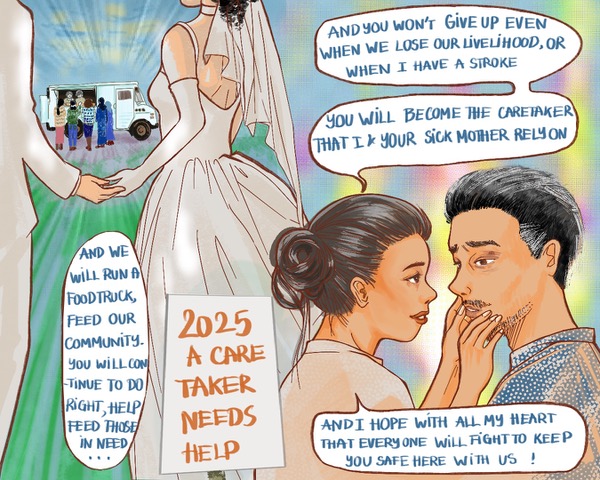
Throughout his days looking after his wife and providing for his family, Tai lives in fear that he will be taken away from his family. His wife’s condition requires a caretaker at all hours of the day. “I’m worried, sometimes I can’t sleep at night. I got a lot to lose out here, I got a family and a wife. I’ve stayed out of trouble over 20 years now, I believe I proved myself to be a better person. Ever since I got out, I’ve been working nonstop, constantly for 20 something years now”.
“There’s this old saying, Làm con thuyền, mới biết sóng to gió lớn. This means you have to be a boat in order to understand how the ocean storms and waves are”. You don’t know how much the boat gets hit with the waves, how many people it has to carry, or what is broken unless you are the boat. You never know how hard someone’s situation is and what they’re going through unless you are them.
Artwork By Ly T. Nguyen
Ly T. Nguyen is a multi-medium artist and scholar based in Minneapolis, whose work reaches towards liberation and a fuller humanity. Follow Ly on Instagram.
Phiên bản tiếng Việt
Tài chỉ mới 7 tuổi khi cha anh đưa ra quyết định định mệnh là trốn khỏi Việt Nam để tìm kiếm một tương lai tốt đẹp hơn. Lớn lên trong một đất nước bị chiến tranh tàn phá dưới sự chăm sóc của mẹ và bà, Tài và gia đình phải đối mặt với cái đói và sự bất ổn. Năm 13 tuổi, Tài, hai em và mẹ anh được phép đoàn tụ với cha anh tại Hoa Kỳ. Khi còn nhỏ, Tài rất háo hức được gặp lại cha mình và bước vào một vùng đất đầy cơ hội. Ngoại trừ cuộc sống ở Hoa Kỳ không như những gì Tài hy vọng. “Tôi nghĩ rằng ở đây sẽ tốt hơn ở Hoa Kỳ nhưng nó không như những gì nó được mong đợi.” Anh đã chứng kiến cha mẹ mình phải vất vả để kiếm sống, làm những công việc nặng nhọc trên dây chuyền lắp ráp.
Ở trường, Tài phải đối mặt với sự phân biệt đối xử nghiêm trọng. Từ nhỏ, Tài thường xuyên bị bắt nạt, bị đá, bị xô đẩy và bị la mắng. Tài luôn rất sợ hãi và không muốn chống trả vì sợ rằng họ sẽ làm mình bị thương nặng hơn hoặc gặp rắc rối. Phải đến vài năm sau, mọi thứ mới bắt đầu trở nên tốt đẹp hơn với cậu. Tài tìm được bạn bè và bước vào giai đoạn trưởng thành của sự sinh tồn. Sau khi xây dựng được ý thức cộng đồng, lần đầu tiên cậu cảm thấy được trao quyền và an toàn. Đúng lúc cuộc sống của Tài bắt đầu cảm thấy an toàn hơn, cậu lại phải đối mặt với những nỗi sợ hãi và trở ngại mới.
Tài, 18 tuổi, đã vướng vào rắc rối làm thay đổi tất cả. Mọi thứ trở nên mơ hồ khi anh phải trải qua gần một năm xét xử. Anh làm theo chỉ dẫn của luật sư, chấp nhận thỏa thuận nhận tội và tập trung vào việc thụ án mà không hề hay biết những hậu quả thay đổi cuộc đời mà nó sẽ mang lại. Vài năm đầu trong tù thật khắc nghiệt. Ngay cả khi ngủ, Tài vẫn sợ hãi và sẵn sàng làm bất cứ điều gì để bảo vệ mình. “Người ta bị giết trong tù liên miên, ngay cả cai ngục và cảnh sát cũng chẳng làm được gì nhiều.” Cảm giác bất an và sợ hãi quen thuộc lại trỗi dậy.
Sau khi được thả ở tuổi 29, Tài đã sẵn sàng bắt đầu lại cuộc sống của mình, “Tôi rất vui nhưng đồng thời cũng sợ hãi, sợ phải quay lại hoặc tệ hơn”. Anh đã nhận được học bổng để học máy tính. Trong thời gian này, anh gặp lại một người bạn từ thời trung học và yêu cô ấy say đắm. Anh hoàn thành việc học và tìm việc làm nhưng thị trường việc làm rất khó khăn. Anh và bạn đời cuối cùng đã chuyển đến Minnesota để kết hôn và tìm thêm cơ hội việc làm. Hai người cùng nhau điều hành một nhà hàng và xe bán đồ ăn lưu động thành công, trở thành mặt hàng chủ lực của cộng đồng ở St. Paul. Tài rất hạnh phúc, nấu ăn bên cạnh vợ và mang đến những món ăn ngon cho cộng đồng.
Đại dịch COVID-19 đã thay đổi mọi thứ. Họ phải đóng cửa kinh doanh, trải qua nỗi mất mát người thân và không còn lựa chọn nào khác. Họ trở thành người chăm sóc hai đứa trẻ được một người bạn của Tài gửi gắm. Cặp đôi này đã đứng ra nuôi dạy chúng, nhưng không thể nhận được bất kỳ sự hỗ trợ nào của chính phủ. Khi các doanh nghiệp bắt đầu mở cửa trở lại, cặp đôi đã cố gắng xây dựng lại doanh nghiệp xe bán đồ ăn lưu động của mình nhưng họ chỉ đủ sống qua ngày. Năm ngoái, Tài và vợ đã phải đưa ra quyết định khó khăn là đóng cửa hoàn toàn doanh nghiệp. Sau khi anh trai vợ anh qua đời, sự căng thẳng và đau buồn đã khiến cô bị đột quỵ và phải nằm viện nhiều tháng. Ngày này qua ngày khác, Tài đến cơ sở chăm sóc 4 lần một ngày trong 8 tháng. Tài đã nghỉ làm để chăm sóc vợ, hy sinh thu nhập của mình. Vào tháng 2, cuối cùng cô đã có thể được đưa về nhà. “Cô ấy là cả thế giới đối với tôi, tôi có thể mất tất cả nhưng tôi thà có cô ấy còn hơn. Cô ấy cần tôi nhất trong cuộc đời cô ấy lúc này, tôi cũng vậy. Sẽ thật đau đớn nếu mất cô ấy, và tôi biết cô ấy cũng nghĩ như vậy.”
Suốt những ngày tháng chăm sóc vợ và chu cấp cho gia đình, Tài sống trong nỗi lo sợ mình sẽ bị tách khỏi gia đình. Tình trạng của vợ anh đòi hỏi phải có người chăm sóc 24/7. “Tôi lo lắng, đôi khi mất ngủ. Tôi mất mát rất nhiều thứ ở đây, tôi có gia đình và vợ. Tôi đã tránh xa rắc rối hơn 20 năm nay, tôi tin mình đã chứng minh được mình là một người tốt hơn. Kể từ khi ra tù, tôi đã làm việc không ngừng nghỉ, liên tục trong hơn 20 năm nay rồi”.
Có câu “Là con thuyền, mới biết sóng to gió lớn”. Bạn không thể biết con thuyền bị sóng đánh mạnh đến mức nào, chở bao nhiêu người, hay hỏng hóc gì nếu bạn không phải là con thuyền. Bạn không bao giờ biết hoàn cảnh của một người khó khăn đến mức nào và họ đang trải qua những gì nếu bạn không phải là họ. Chúng tôi hy vọng câu chuyện của Tài có thể phần nào làm sáng tỏ hoàn cảnh của anh và quyên góp đủ quỹ để giúp đỡ anh và gia đình.
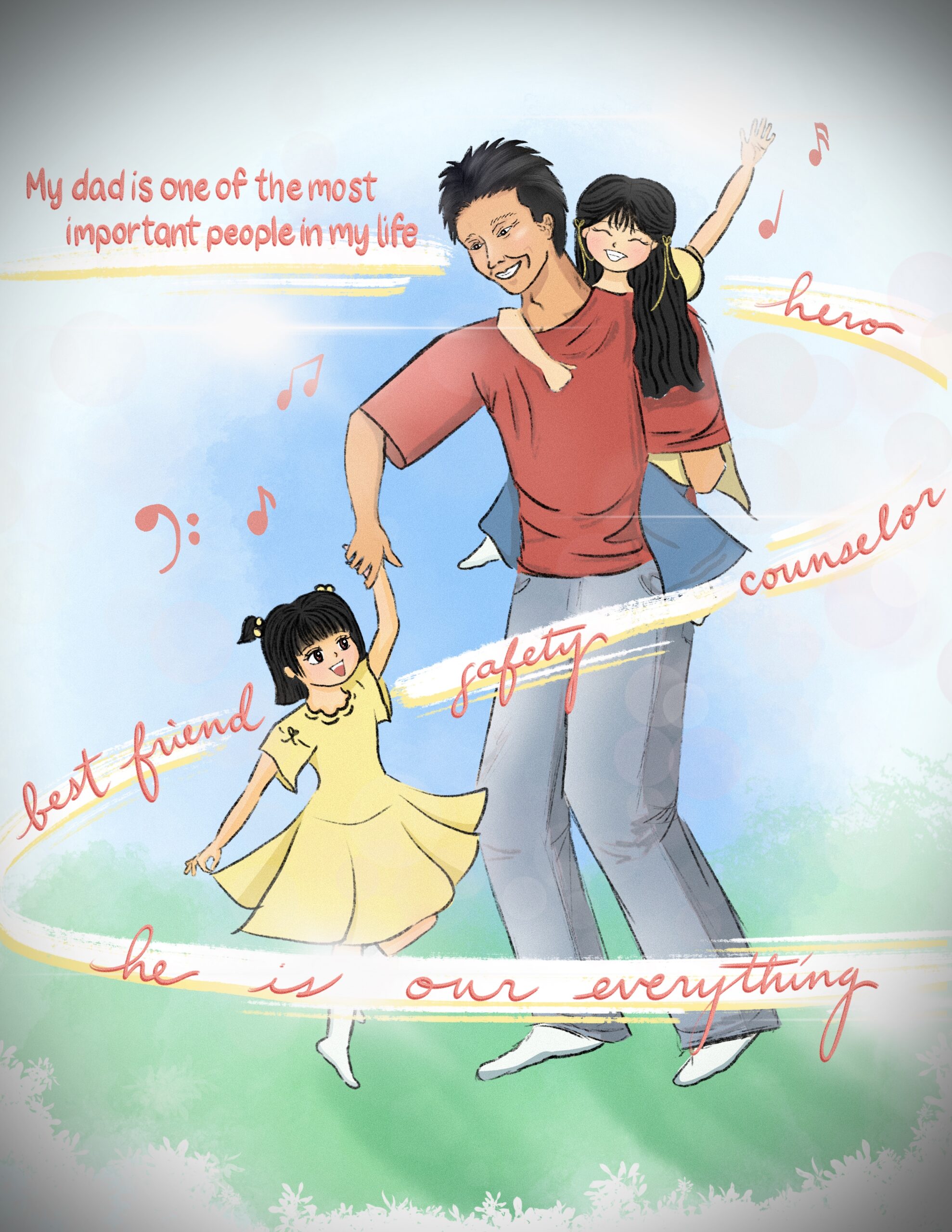
My parents came to the United States as refugees in 1988 for freedom and hopes for a better life. They spent decades building a life from nothing and made Minnesota their home. They worked multiple jobs, raising children, farming, gardening, and being involved in the Hmong community. Although we grew up with limited means, my parents did their best to keep us safe and give us a happy childhood. They took us to the parks and the zoo when they were able to. One of my most precious memories with my dad is when he would join my sisters and I in the basement to dance. Dancing was our way of finding joy and connection. It was how my siblings and I bonded, laughed, and spent time together almost everyday.
My dad fled war and made a life for himself in America, believing it was his home. That home was taken away when he was deported back to Laos. Seeing my dad so heartbroken made me realize how deeply his grief is tied to a lifetime of displacement and sacrifice. The truth is, Hmong people do not have a country or a piece of land we can truly call home. My dad’s home is where his family is. And his family is in Minnesota. Let me tell you how my dad was taken from us, through the eyes of a child who fought hard to keep her family from being torn apart.
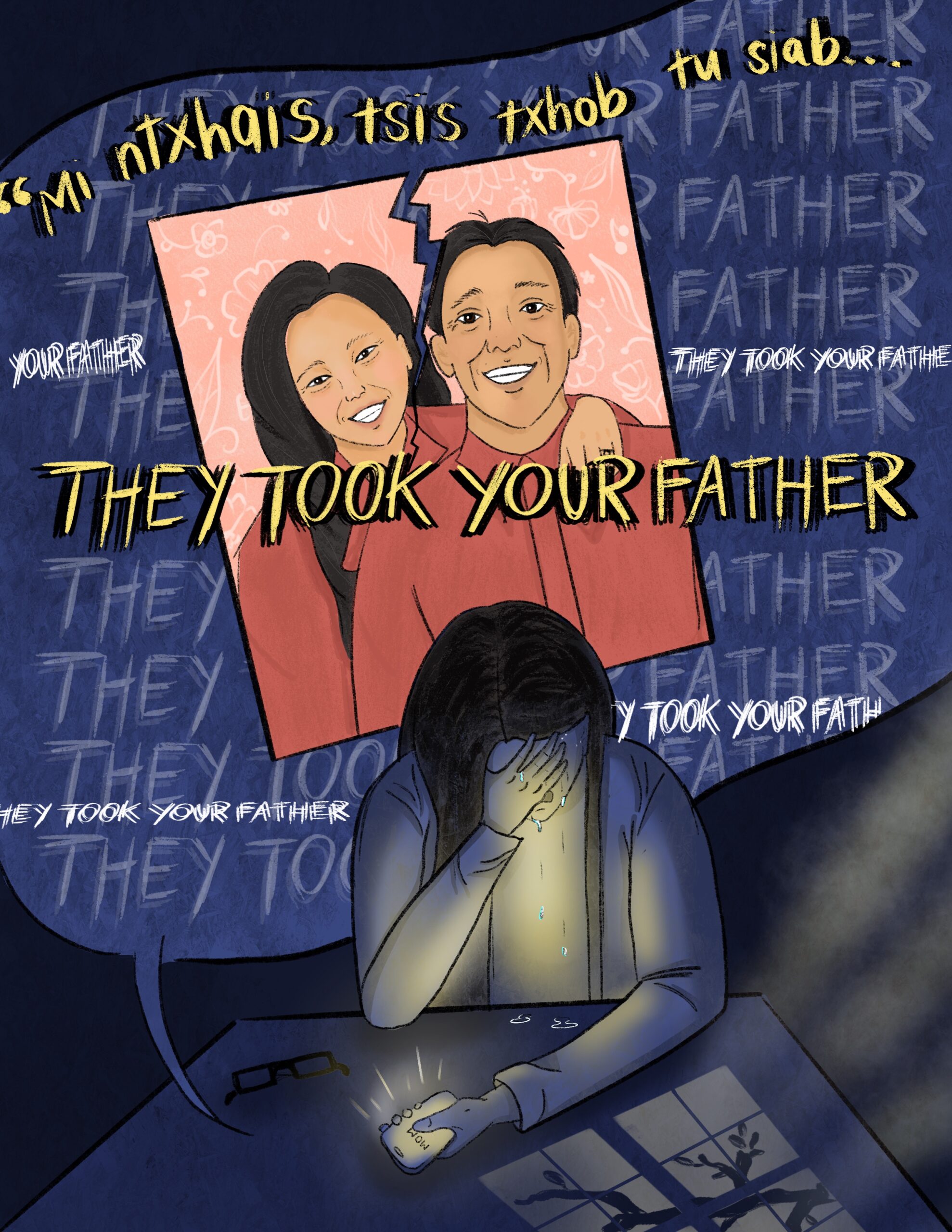
On June 11th, 2025, I woke up at 7:30 am to a phone call from my mom, which was unusual so early in the morning. In her calm, collected voice, she told me, “Tsis txhob tu siab. I need to tell you something, but please don’t be sad. ICE took your dad. We were driving to the farm. There was a black car following us the entire time. When we made a stop at a gas station, they took your dad.”
There was a long, quiet pause. My mom tried to soothe me and told me not to worry. The call was short, but the moment it ended, I broke down. The surge of sadness was overwhelming, tightening around my heart. I went to my husband, hoping to explain, but words failed me. All I could do was fold forward, clutching my chest as sobs tore out of me and the reality finally set in. My husband rubbed my back, crying with me, knowing exactly what had brought me to this state.
I took off work that day to figure out what to do. I did my best to locate where they took my dad and found that he was at the Bishop Whipple Federal Building in Minneapolis, Minnesota.
My dad was there for a couple of days before they transferred him to Freeborn County Jail in Albert Lea, Minnesota. I spoke to my mom about proceeding with looking for a lawyer or attorney. A couple of weeks went by, my family and I spoke to two attorneys. We were told there was nothing we could do to stop the deportation and to prepare for it. Hearing that ignited an anger within. I was angry at my parents for going to the farm. I had begged them to stay home. We’d been afraid of this for weeks. But how could they? Farming was their way of life.
Above all else, I was angry at the system and towards those who voted for this and those who chose not to vote at all. For the next four months, while my dad was detained, my world felt like it was collapsing. Grief followed me through every stage of the process. When hope disappeared, anger was what kept me moving forward. There was a lot of kev tu siab (deep heartbreak). We were only allowed to see my dad through video calls for 30 minutes, even though we drove two hours to visit him at the ICE detention center in Albert Lea, Minnesota.
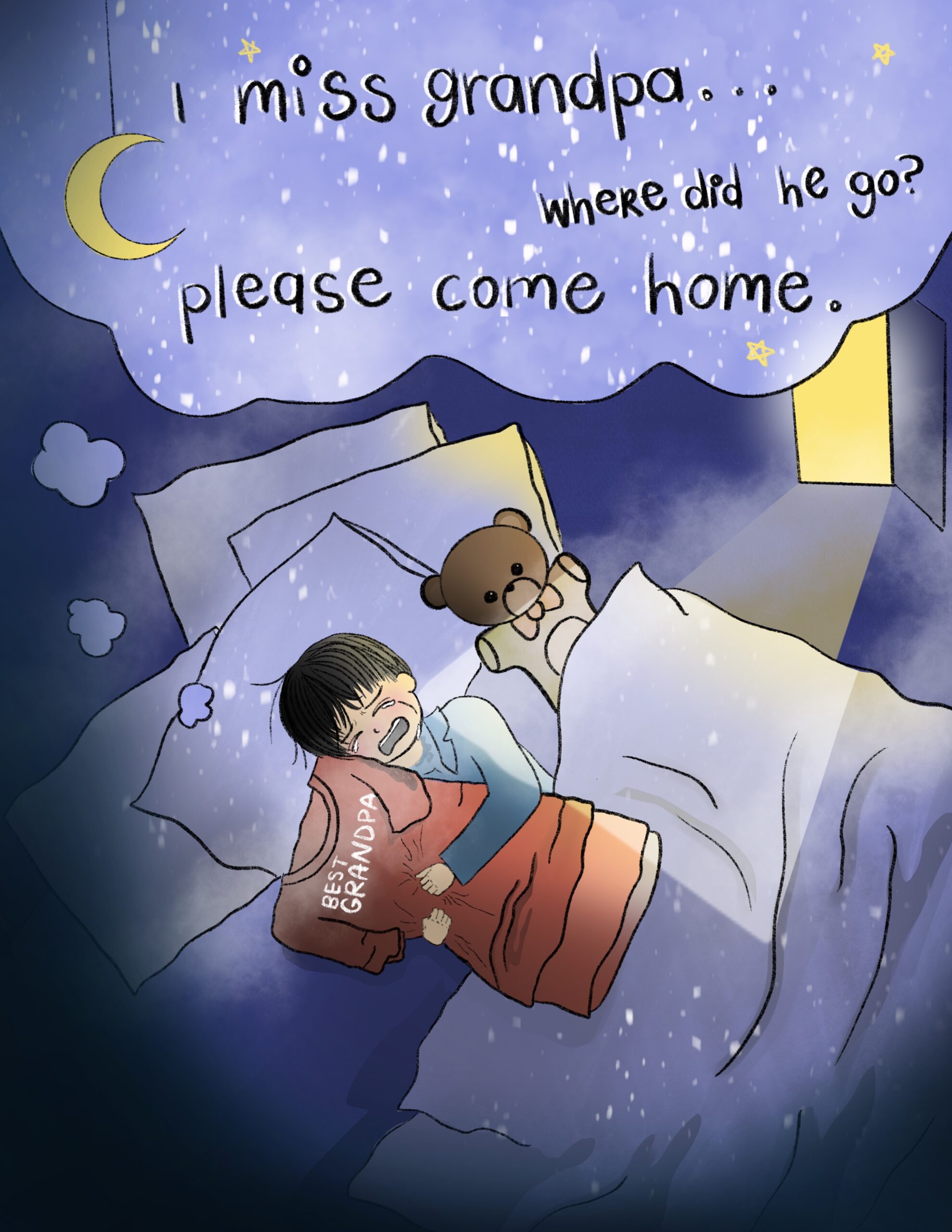
My younger nieces and nephews often asked for my dad, unable to understand why their grandpa couldn’t come home. One of my nephews was especially attached to my dad. To comfort my nephew, my mom draped my dad’s shirt over a pillow and gave him another to wear, so he could hug the pillow to sleep. Some nights, he cried until four in the morning, begging for his grandpa to come home.
On July 27th, my mom went to the ER and was hospitalized due to a farm related injury that required multiple surgeries. My mom was overwhelmed by the stress and trauma, which led to the neglect of her health. I took many days off work to stay with her at the hospital for two weeks. I helped her with daily activities, from feeding her food and helping her sit up in bed, to assisting in her walking, using the bathroom, and showering. After being discharged, I monitored her health closely for several months until she began to show improvement.
I was also dealing with my own health issues and had to visit urgent care several times. I had wrist and ankle joint aches, which later led to inflamed joints, and constant migraine.
The doctors couldn’t determine what was wrong. They prescribed pain medication and advised me to return if the symptoms worsened. The stress of everything I was dealing with was wearing my body down.
After my dad was detained, I often asked to work remotely because I couldn’t make it through the day without breaking down. It was impossible to focus and most nights I lay awake until two or three in the morning, desperately trying to figure out how to help my dad, take care of my mom, and figure out what was wrong with my health.
At Freeborn County Jail in Albert Lea, my dad was detained alone and was not allowed to interact with other inmates. He cried often, sharing with my mom how deeply he missed us. To cope, he would sleep for hours on end, trying to escape reality. “I don’t know how I’m going to get through this. When I wake up, I force myself to go back to sleep. When I am awake, there is nothing to do, but to stare at a white brick wall.” My dad was sinking into depression, feeling helpless and trapped. I made sure his account always had money, so he wouldn’t feel burdened by needing to call us often.
Even during these hard times, he persisted. My dad has always been a survivor. He’s been through many dark things. He survived war and built his life in America. He has had multiple strokes in the past and overcame it. He had a spinal injury that led to permanent disability and chronic pain. He also has chronic leg pain that causes him to limp a little bit when he walks.
On August 10th, my dad was transferred to an ICE detention center in Alexandria, Louisiana. Because of his chronic leg pain, he was placed in a wheelchair during the flight. When they arrived, confusion broke out between ICE, the pilot, and the detention staff. They were supposed to board another plane within the hour to be deported. The detention center was not prepared to receive so many people. My dad believes it may have been flight related problems or expired travel documents that caused the delay. Therefore, the detainees remained shackled and were forced to sleep on the airplane overnight. The next day, they were finally brought inside, but kept in the lobby, where there were not enough blankets, pillows, towels or food for everyone.
The following day, ICE transferred my dad and the group to the Jena/LaSalle Detention Facility in Louisiana. Due to the limited bottom bunk availability, my dad was separated from his group and placed in another housing unit. Although my dad speaks Hmong and has limited English, the Spanish-speaking detainees in his unit showed kindness and support by offering him a bottom bunk and assisting him with mobility, phone access, and meals. As a gesture of appreciation, I added extra funds to his account so he could purchase snacks for them. We were informed by our community that Louisiana, Texas, and Arizona are the last staging facilities where detainees are held before they get on a plane to be deported out of the United States.
Amidst everything going on, my brother-in-law passed away unexpectedly on August 12th. While most of the funeral planning was handled by my in-laws, I assisted when possible by attending appointments and family meetings. His passing felt surreal. My husband and I grieved the loss of my brother-in-law’s life while trying to remain strong for our families. The house felt even more empty, and there were moments when we instinctively thought that my brother-in-law was still with us, only to be reminded that he was truly gone..
On September 24th, my dad and four other detainees were transferred back to Freeborn County Jail in Albert Lea, Minnesota. It was the first good news my family had received in a long time. We believed the move was due to expired travel documents that needed to be renewed. Hope returned, and I quickly reached out to an immigration attorney to begin the habeas corpus process. However, that hope was short-lived because ICE transferred my dad back to Louisiana, to the Pine Prairie ICE Processing Center on Oct 17th. Because my dad was moved out of the state of Minnesota, our attorney could no longer pursue habeas corpus for him. Disheartened, I redirected my energy towards preparing for my dad’s release in Laos by securing a Lao citizen sponsor for my dad, money, food, medications, and housing.
On October 20th, my husband and I were laid off. The loss of income forced us to rely on our savings for basic necessities. The combined griefs and financial uncertainty was overwhelming.
On October 23rd, my dad was deported from the United States. He arrived in Laos on October 26, the same day as my brother-in-law’s funeral. During transport to Laos, my dad was, again, wheelchair bound due to this chronic leg pain. He was hungry and weak when he arrived in Laos. A day after his arrival, I was able to talk to my dad for only five minutes. They were charging $20 USD for 5-minute phone calls. Ten days later, he was released from the processing center and stayed with the sponsor and his family for a couple of weeks to complete the immigration process.
My dad was able to find a house to live in with a few other deportees. He’s adjusting to his new environment and lifestyle. After two months, he is finally settling in. He often tells us that he misses us. I call my dad at least once a day to check up on him and talk to him about my daily life or anything worth mentioning.
One day, my mom shared that when my dad saw other children in Laos, he cried. He asked a relative of the sponsor if he could hug their child who is about the same age and height as one of my nephews. My dad misses his grandchildren so much that hugging a stranger’s child helps calm his sadness and loneliness in his heart a little bit.
My dad is one of the most important people in my life, and I am very close to him. He represents not only my father, but my counselor, therapist, and best friend. He gives me a sense of security, protection and guidance. My dad is a talkative and intuitive person. He is funny, loving, and caring.
My dad is a busybody and cannot stay still. He knows how to do everything from cleaning, cooking, child care, and fixing things. My parents were always in survival mode and they were always stressed trying to live their best life with what they had.
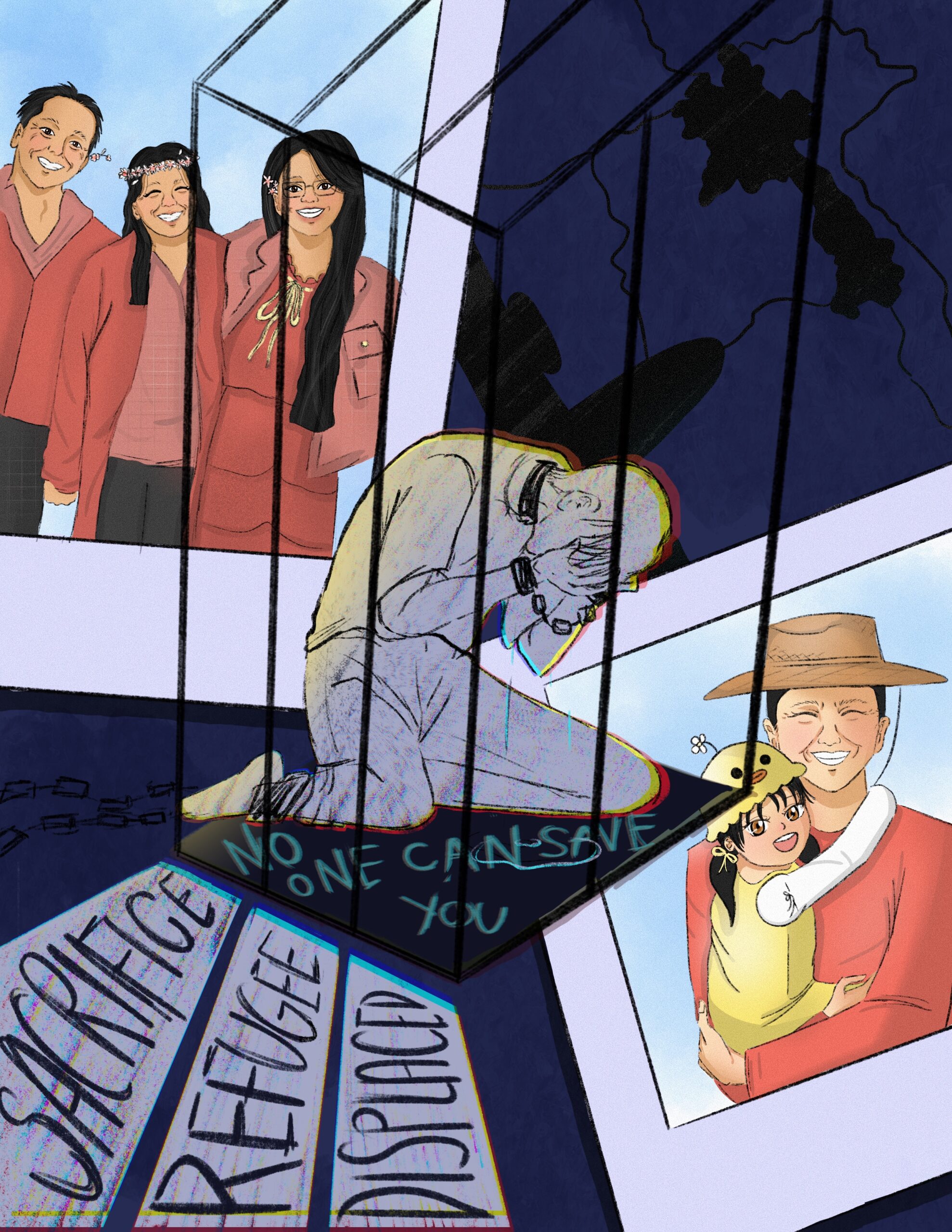
This is one of the hardest experiences I’ve been through in my entire life. I was continuously told that no one can help me and that there is nothing I can do to bring my dad back home. The hardest part was having hope and losing hope again and again. I had to learn the lesson that no one is coming to save my dad; it was all up to me to help him to the best of my ability. To support my dad, I sacrificed everything. I often wondered how far I would be willing to go.
I thought they were finally able to live peacefully with most of their children grown up. That peace was taken away and now they’re in survival mode again after the separation. After watching my parents go through so much to survive, it is devastating to see them in so much despair.
I wish more people could understand the gravity of a family being separated. This is someone’s dad, their husband, their grandpa, their everything. I didn’t know that June of 2025, was going to be the last time I would see him in person.
Sometimes when I visit my mom, I would go to my parents’s room and just sit on their bed in silence. Recalling the memories and how much I wish my dad was home. My family never had a chance to say goodbye to him and now he’s across the world. Phone and video calls will never be enough to fill in the void of his absence.
Artwork By Kay
Kay is a proud descendant of Southeast Asian refugees, a legacy that is deeply rooted in resistance, love, and belief that another world is possible. Art is one way in which we get to practice joy, heal, and resist. As a displaced Hmoob person in Mni Sota Makoce, she organizes through a lens of (re)imagination and world-building towards liberated futures. Follow her artwork on Instagram or email her at [email protected].
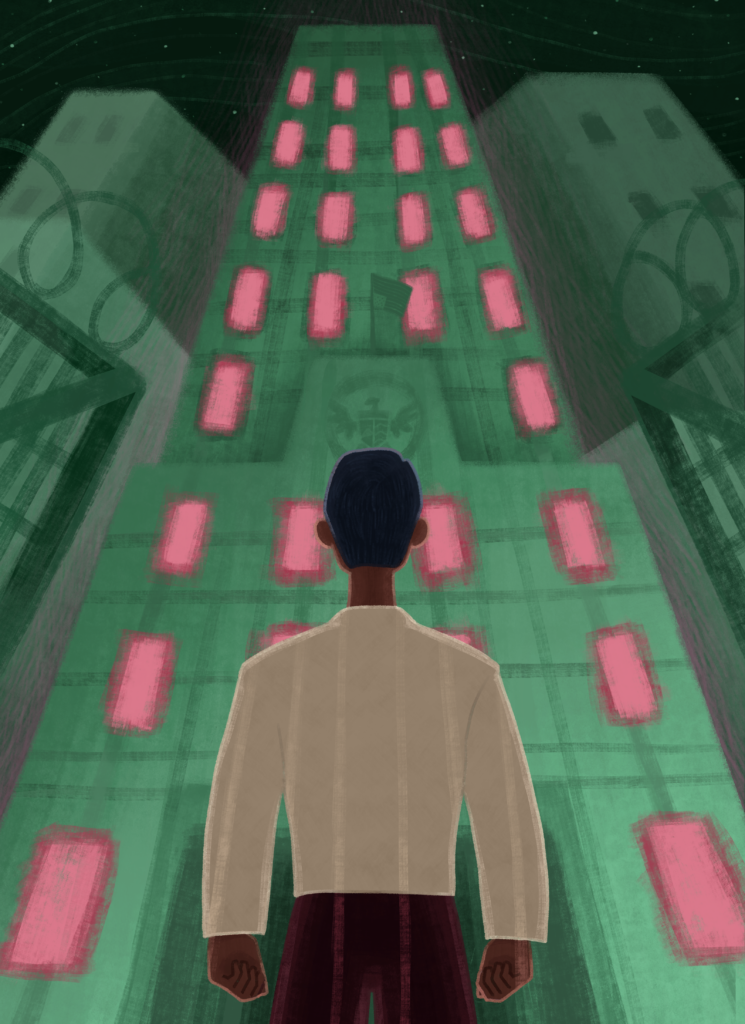
The walk into freedom was a clean seam. Not a split between past and future, but a precise surgical incision from one confinement into another. Thirty years vanished, not into air, but into the unyielding grip of a new jurisdiction. The state’s door unlocked on my key, only to open onto a waiting geometry of Immigration and Customs Enforcement, stark and cold. The sum- my debt -which I had paid and in the space of a beat became payment upon account for a deeper, newer, nullification of my person. I braced for the world’s dizzying speed. I instead went directly into the cold and terrifying ambivalence.
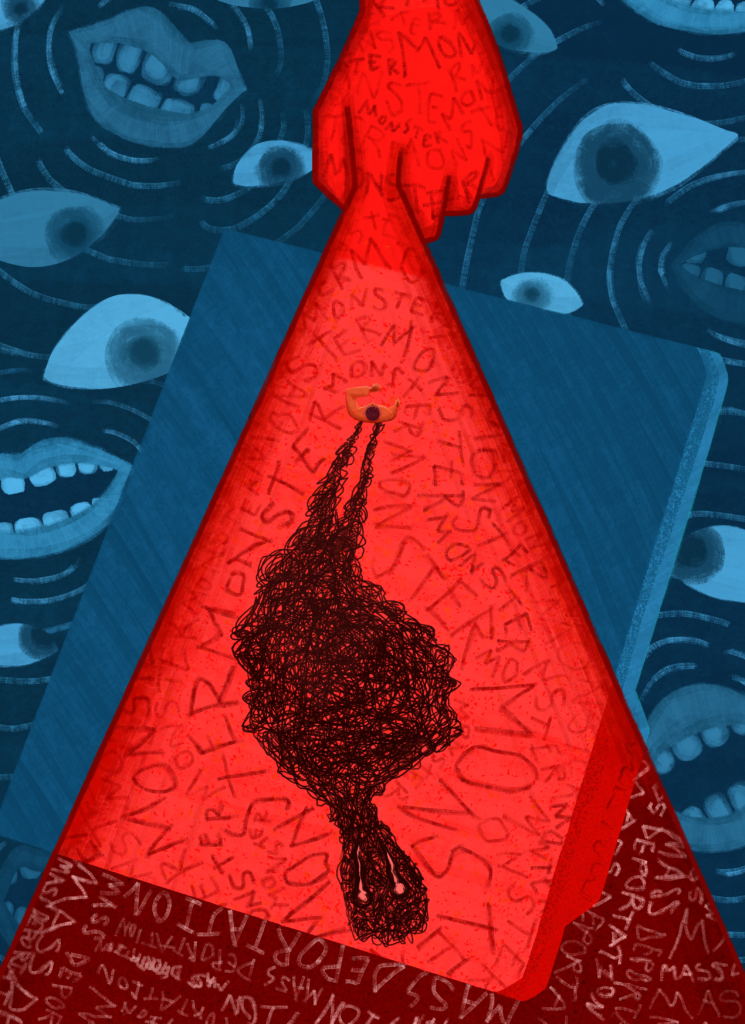
This is not freedom, this is hypothesis. This is the mask of Liberty. This feels a lot like being walked on a leash of some distant office. I exist always in italics between parentheses. Perpetually dangling on the line of a stroke of a pen. Each morning holds a heavy sense of political static in “mass deportation”, and, I feel that spotlight shine on my file.
I am the necessary monster to justify campaign speeches. The debt I have paid – for my past crime – is no longer sufficient.
A slow burning, grinding friction from this “paradox of the labor”: I have to work due to the terms and conditions of my parole. Yet according to my Immigration status I cannot and that I should not, there are no available prospects. With nothing to stand upon this ground, with my body bound at my feet. The chance of a “real” position, with any dignity, a future or pay check, this is an administrative impossibility. I am left as a consequence with an occupation within the ghostspace of the economy: day-jobs, cash-money and disposability. No longer so much as just a man on work as a shadow attempting to work away from eyes and ears that demands my solvency.
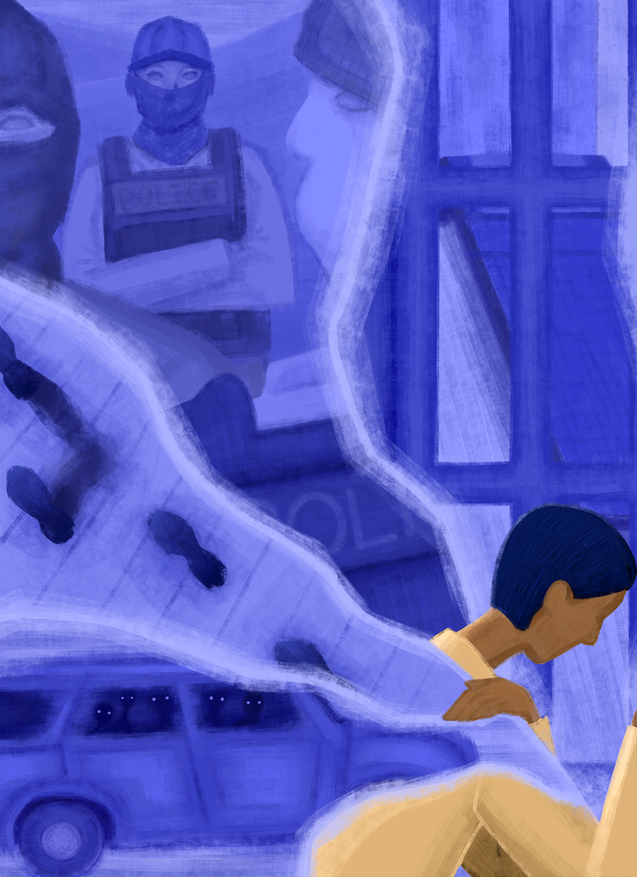
Fear is not an event and though never sudden, cold and steady pressure on my shoulders: an incapacitating chill. Every slowing car on street outside is a cold current in my spine. Every heavy footfalls, on the porch and every dark suit, dark in my eyes (uniform dark, deep in the dark eyes memories of detention and it is fear) shocks like live wire.
I see not a hallucination, I have taken paranoia’s logic on: ICE are a presence somewhere: on the watch, somewhere my electronic self (the flagged in the database) exists. Somewhere an ICE operative might have me in his eyes. There are tripwires in normality, my “real self”, who wants me to sign lease, open bank accounts and get driver’s license – data/willingness to play “the game” in exchange they see location for the “real” me. To root myself in terra-firma this is a trip wire. I am above trap-door. Which some act from high above of some invisible hand by this Federal act sets this trap-door going: I go into the long dark.
This bi-parole: bureaucracies poetry of cruelty The walls are now invisible – made not with rock, nor mortar nor cement – by policy memos, politic-sounding statements (sound-bite); and these are invisibly high, these are as real as bricks and concrete could be. Instead of the certainty of a date which used to hang over me. There is now an unknown moment to fear. I imagine and fear that moment sometimes out of the darkness and black of some hour: (this time not detention, this time a rounding up-a raid. ) a policy change; software glitch triggered or an algorithms decision. Future sold to the highest bidder — not, I mean; this is out of my hands now, instead to the (arbitrary) and unseen whims of this political machine, a machine that regards with such blase-indifference of my life as disposable item or collateral.
I, performed under the original contract which is done and have performed the necessary sacrifice required of me; I have payed full price.
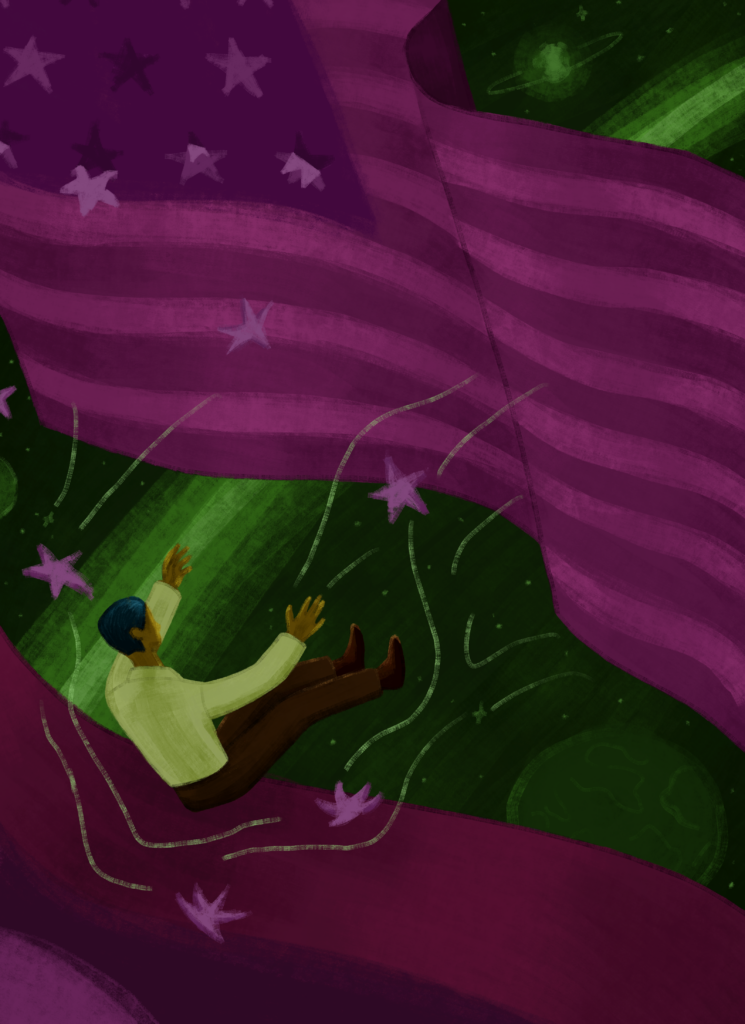
But, a society riddled with the fear it breeds now, which it so feverishly propagates says that there is no remission to re entry for souls such of mines? – that there is none for them because of their past sins and now the unpardonable sin of being birthed in a certain place. I am not rebuilding. I am orbiting, with the slow anxieties of life I have yet to form here. Yet trying also to be here in the place that is my home in THIS COUNTRY WHERE THEY ARE SEEKING OUT LOUDLY to remove me.
Artwork By Hongfa Norasingh
Hongfa Norasingh is a first-generation Southeast Asian American creative born to immigrant parents from Laos. She is a Twin Cities based digital graphic designer and illustrator who thrives on fantastical and visual storytelling. Since childhood, Hongfa’s self-expression continuously develops and focuses on the invocation of joy, adventure, and the spark of imagination for the what ifs and what can be.
About The Writer
H.S. is a Lao justice-impacted artist, writer, and restorative justice practitioner whose work explores themes of healing, identity, and transformation:
I grew up in South Minneapolis and the realities of life on the streets often left young people with few real alternatives. Before I knew it, I was caught up in the familiar cycle of youth, gangs, drugs and bad choices typical of growing up in that neighborhood, which eventually set me on a course that culminated in a life sentence in prison.
However, prison never took away my will to blossom from inside. I was not just another prisoner confined within four walls, so I grabbed my freedom to define my reality my way. What has been referred to as a sentence eventually turned into a mission of education, self-improvement and helping others – I used the time as an opportunity, transforming into a mentor, tutor and community leader at the same time.
I dedicated myself to study, attaining academic qualifications and mastering vocational skills, always with the hope that on account of this new knowledge and determination, I might perhaps be granted the hope of a potential “future.” Yet it was just another concept, that I used my best to grasp because a life sentence would forever bear the heavy burden of “what if” – meaning I would live each day wondering if I would ever go home. I never allowed fear, dread or ‘what ifs’ to dictate myself to them nor decide the kind of dreams or person I could be inside of me, so I hoped, I believed, I prayed.
The years crawled by as I kept believing that, sooner or later, I would eventually return, reborn, to my family, community and home, leaving prison way wiser, harder working and stronger in its stead. The momentous year was 2024 when through clemency from the Governor, I finally saw those prison walls crumble around me. It was only fitting after the perseverance, determination, knowledge cultivation, hard work and training – I made a comeback. Redemption & Education power of, Faith of change of people when they have opportunities- all encapsulated by journey.
